
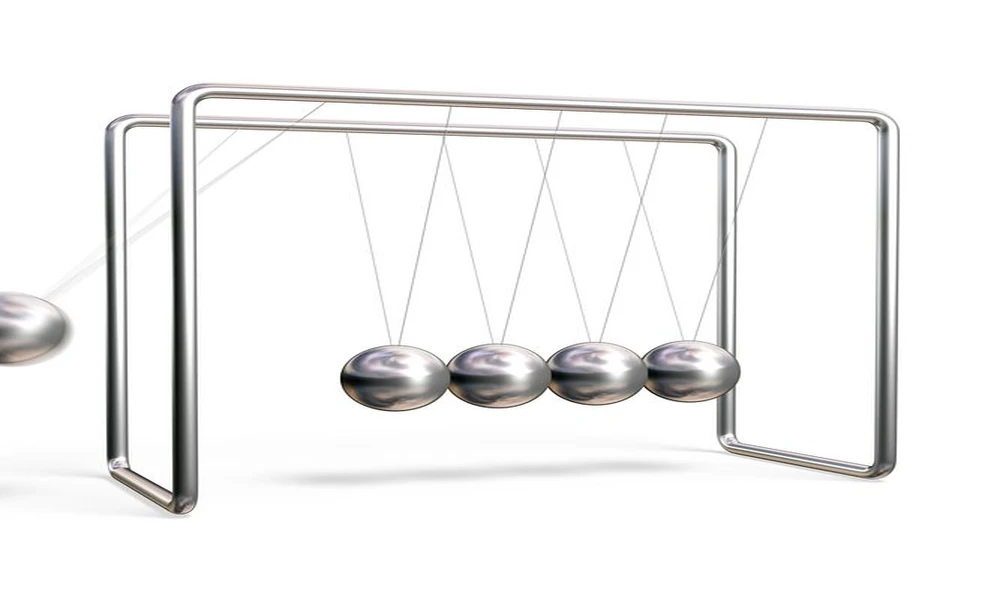

The Newton’s Cradle simulator is a fun, interactive science tool that helps young learners see how energy travels from one object to another created by Active Kinetic 1. By clicking buttons to drop one, two, three, or four balls, students can easily watch how a push on the left side sends the exact same number of balls swinging out on the right. Simple on-screen labels let kids switch between tracking speed and energy, helping them build an early understanding of cause and effect in physics without needing complicated maths.
The Newton’s cradle offers a memorable setting for learning about Sir Isaac Newton’s three laws of motion. Rather than presenting each law only as a written definition, a teacher can use the swinging metal spheres to identify where forces act, how motion changes and why interacting objects respond to one another. The apparatus is especially useful when students are encouraged to explain the movement before being shown the relevant equations.
Newton’s First Law concerns inertia: an object remains at rest or moves at constant velocity unless a net external force changes that state. The central balls initially remain stationary, and their behaviour changes when the collision forces reach them. Newton’s Second Law describes how net force produces acceleration, expressed for constant mass as F = ma. Students can observe that gravity accelerates a released pendulum ball and that the large forces during impact rapidly alter the balls’ velocities.
Newton’s Third Law states that interacting bodies exert equal and opposite forces on one another. At each contact between adjacent spheres, the forces occur as a pair, even though the balls may have different instantaneous movements. This distinction is worth emphasising: equal and opposite contact forces act on different objects and therefore do not cancel as forces on one individual ball.
A Newton’s cradle also reveals that the three laws work alongside conservation principles. The characteristic movement of an outgoing ball is explained most completely by combining forces, impulse, momentum conservation and approximately elastic impacts. Students can test different release configurations, sketch force diagrams and compare predictions with slow-motion recordings. A simple question-and-answer exercise can further challenge students to distinguish forces acting during flight from those acting at impact. This makes the cradle a versatile classroom learning aid for developing a coherent understanding of Newtonian mechanics rather than memorising three separate rules.
The Newton’s cradle simulator also shows what happens in the real world versus an imaginary friction-free world. Kids can turn on the decay mode to watch how clicking sounds and air resistance slowly tire the swinging balls out until they stop. There is even a special “Paradox” button that lets students test a fun trick question, showing why dropping one ball can never make two balls fly out at half speed alongside slow-motion controls that make every bounce easy to follow.
Newton’s Cradle Simulator
Compare classical mechanical sphere impacts with parallel-face Active Magnetic Cradle (AMC) dipole carriages.
|
Impacts: 0 | Energy Retained: 100.0%
Interactive Newton’s Cradle Simulator for Kids: Learn How Energy Moves
