
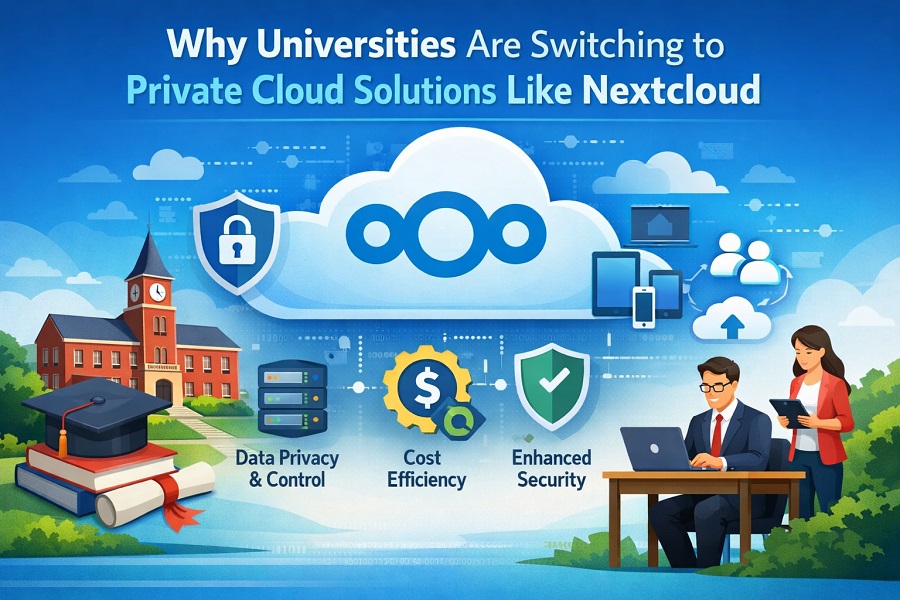

Higher education is rapidly evolving in the digital age. Universities now rely heavily on cloud platforms for storing academic data, enabling collaboration, and supporting research initiatives. However, as dependence on cloud technology increases, so do concerns around data privacy, compliance, and long-term costs.
For years, institutions have depended on public cloud providers like Google Drive and Microsoft OneDrive. While these platforms offer convenience, they also introduce significant limitations—especially when it comes to control over sensitive data and regulatory compliance.
As a result, universities worldwide are making a strategic shift toward private cloud solutions like Nextcloud. This transition is not just a technological upgrade—it’s a move toward greater autonomy, security, and sustainability in academic IT infrastructure.
The Growing Challenges with Public Cloud in Universities
Public cloud platforms initially gained popularity due to their accessibility and ease of use. However, universities are increasingly recognizing their drawbacks.
Data Privacy and Security Risks
Universities handle vast amounts of sensitive information, including:
- Student records
- Faculty data
- Confidential research projects
Public cloud providers often store data across multiple regions and jurisdictions, raising concerns about unauthorized access and data sovereignty. Institutions have limited visibility into how their data is managed, which creates potential risks.
Vendor Lock-In and Lack of Flexibility
Once a university adopts a specific cloud ecosystem, switching providers becomes complex and expensive. This “vendor lock-in” restricts institutions from adapting to new technologies or changing needs.
Rising and Unpredictable Costs
Public cloud pricing models often appear affordable at first but can quickly escalate as usage grows. Costs increase with:
- Storage expansion
- Additional users
- Premium features
For universities operating on tight budgets, this lack of cost predictability becomes a major concern.
Limited Customization for Academic Needs
Every university has unique workflows, research requirements, and collaboration models. Public cloud platforms offer limited customization, making it difficult to tailor solutions for specific academic use cases.
What Is a Private Cloud Solution?
A private cloud is a dedicated cloud environment where an organization has full control over its infrastructure, data, and access policies.
Unlike public cloud services, private cloud solutions allow universities to:
- Store data in specific geographic locations
- Customize features and integrations
- Maintain complete ownership of their digital assets
Private cloud environments can be:
- Self-hosted, managed by the institution’s IT team
- Managed hosting, where a provider handles infrastructure and maintenance
This flexibility makes private cloud particularly attractive for educational institutions seeking both control and efficiency.
Why Universities Are Choosing Nextcloud
Nextcloud has become a leading private cloud platform in the education sector, offering a combination of security, flexibility, and scalability.
Full Data Ownership and Privacy
One of the biggest advantages of Nextcloud is complete data ownership. Universities retain full control over where and how their data is stored.
This ensures:
- No third-party data mining
- Enhanced protection of research and student information
- Greater transparency in data management
Simplified Compliance with Regulations
Universities must comply with strict data protection laws such as GDPR and FERPA. Nextcloud makes compliance easier by offering:
- Data residency control
- Detailed audit logs
- Advanced access permissions
This reduces legal risks and ensures institutions meet regulatory requirements.
Open Source Flexibility
As an open-source platform, Nextcloud allows universities to:
- Customize features according to their needs
- Integrate with existing systems
- Avoid dependence on proprietary vendors
This level of flexibility is essential for institutions that require tailored solutions.
Cost Efficiency at Scale
Unlike subscription-based SaaS platforms, Nextcloud offers predictable and scalable pricing. Universities can avoid per-user licensing fees and reduce long-term operational costs.
For large institutions, this translates into significant financial savings.
Built for Academic Collaboration
Nextcloud is designed to support collaborative environments, making it ideal for education.
Key features include:
- Secure file sharing
- Real-time collaboration
- Group project management
- Remote learning support
These capabilities enhance productivity for students, faculty, and research teams.
Key Use Cases of Nextcloud in Universities
Nextcloud supports a wide range of academic applications.
Student File Storage and Sharing
Students can securely upload, store, and share assignments and coursework.
Research Data Management
Sensitive research data can be stored with strict access controls, ensuring confidentiality and integrity.
Faculty Collaboration
Departments can collaborate on research, curriculum development, and administrative tasks seamlessly.
Secure Document Exchange
Universities can safely share confidential documents with internal and external stakeholders.
Remote and Hybrid Learning
Nextcloud enables easy access to learning materials, supporting both in-person and remote education models.
Private Cloud vs Public Cloud in Education
When comparing private and public cloud solutions, the advantages of private cloud become clear.
- Data Control: Full ownership vs limited control
- Security: Higher protection vs shared environments
- Cost: Predictable vs variable pricing
- Customization: Extensive vs restricted
- Compliance: Easier vs complex
For universities, these differences can significantly impact long-term efficiency and risk management.
How Universities Can Transition to Private Cloud
Switching to a private cloud may seem complex, but a structured approach simplifies the process.
1. Assess Current Infrastructure
Evaluate existing cloud systems and identify gaps or inefficiencies.
2. Define Compliance Requirements
Understand legal obligations related to data protection and privacy.
3. Choose the Right Hosting Model
Decide between self-hosted or managed Nextcloud hosting based on internal capabilities.
4. Plan Secure Data Migration
Ensure all data is transferred safely without disruption.
5. Train Users
Provide guidance to staff and students for smooth adoption.
Why Managed Nextcloud Hosting Is the Smart Choice
While self-hosting offers control, it requires significant technical expertise. Managed hosting solutions simplify the process by providing:
- Automated updates and maintenance
- Enhanced security monitoring
- Reliable uptime and scalability
This allows university IT teams to focus on innovation rather than infrastructure management.
The Future of Cloud in Higher Education
The shift toward private cloud is part of a broader trend in higher education.
Universities are increasingly prioritizing:
- Data sovereignty
- Open-source technologies
- Cost efficiency
- Long-term sustainability
Private cloud solutions like Nextcloud align perfectly with these goals, making them a cornerstone of future academic infrastructure.
Conclusion
Universities are moving away from traditional public cloud platforms in favor of solutions that offer greater control, security, and flexibility.
Private cloud platforms like Nextcloud empower institutions to:
- Protect sensitive data
- Meet compliance requirements
- Reduce costs
- Foster collaboration
As the demand for privacy-first and scalable solutions grows, Nextcloud is emerging as a preferred choice for forward-thinking universities.
FAQs
What is Nextcloud used for in universities?
Nextcloud is used for secure file storage, collaboration, research data management, and remote learning support.
Is private cloud better for education?
Yes, it offers better data control, security, and compliance compared to public cloud solutions.
Can universities replace Google Drive with Nextcloud?
Yes, Nextcloud provides similar features with enhanced privacy and customization.
Is Nextcloud secure for academic use?
Yes, it offers strong encryption, access control, and full data ownership.
